
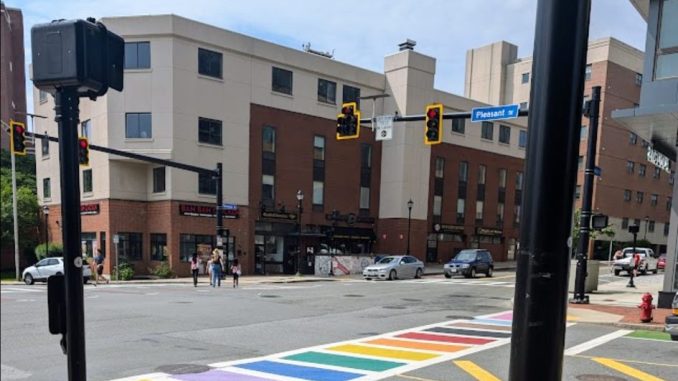
On Tuesday Malden announced a dual victory for local economic development, winning a competitive three-year state partnership to accelerate downtown growth while simultaneously funding road safety improvements in residential neighborhoods.
Leading the announcements is the city’s selection as a Transformative Development Initiative (TDI) district by MassDevelopment. This highly competitive designation grants Malden a comprehensive three-year partnership with the state’s finance and development agency with the goal of accelerating economic growth within the downtown area.
“I’m elated,” said Ward 3 Councilor Amanda Linehan, who serves as City Council president. “Ten years ago one of our housing planners left City Hall to join the inaugural class of TDI fellows, and we’ve been eager to join the program ever since. Finally it’s our turn.”
While the TDI program focuses on the commercial center, the city also announced a successful bid for infrastructure funding to help make Maplewood Square and surrounding areas safer. The $500,000 that the Massachusetts Department of Transportation (MassDoT) awarded the city through the Complete Streets Funding Program will be earmarked to overhaul key corridors, specifically Lebanon St. and the busy intersection of Main St., Eastern Ave., and Madison St.
‘Major victory’ for downtown economy
The TDI program, which officially launches on July 1, will bring a significant influx of resources for Malden’s downtown. As part of the program, MassDevelopment embeds a full-time economic development fellow in the city for three years to provide on-the-ground expertise. The program uses an “accelerator model” to provide technical assistance, real estate development support and grants to foster small business stability and arts integration.
Since 2015, MassDevelopment has spent $50 million in TDI districts on technical assistance, real estate investments, grant programs and fellows. The agency says that money has directly influenced more than $168 million in public and $314 million in private investment in the districts, along with $8 million in philanthropic investment. Malden isn’t completely new to this work — in 2015, MassDevelopment, Malden and Everett convened an Urban Land Institute Technical Advisory Panel that helped kick off renewal in the Commercial St. Corridor. The biggest takeaway from that study was a recommendation to use the Malden River as the central “organizing element” for future development.
But it’s the first time the city will benefit from the TDI accelerator model.
“And the timing is perfect,” said Linehan. “We just hired a new senior-level economic development expert in our Office of Strategic Planning and Community Development, so this fellow will be well paired to do a deep dive over three years into what can take our downtown to the next level.”
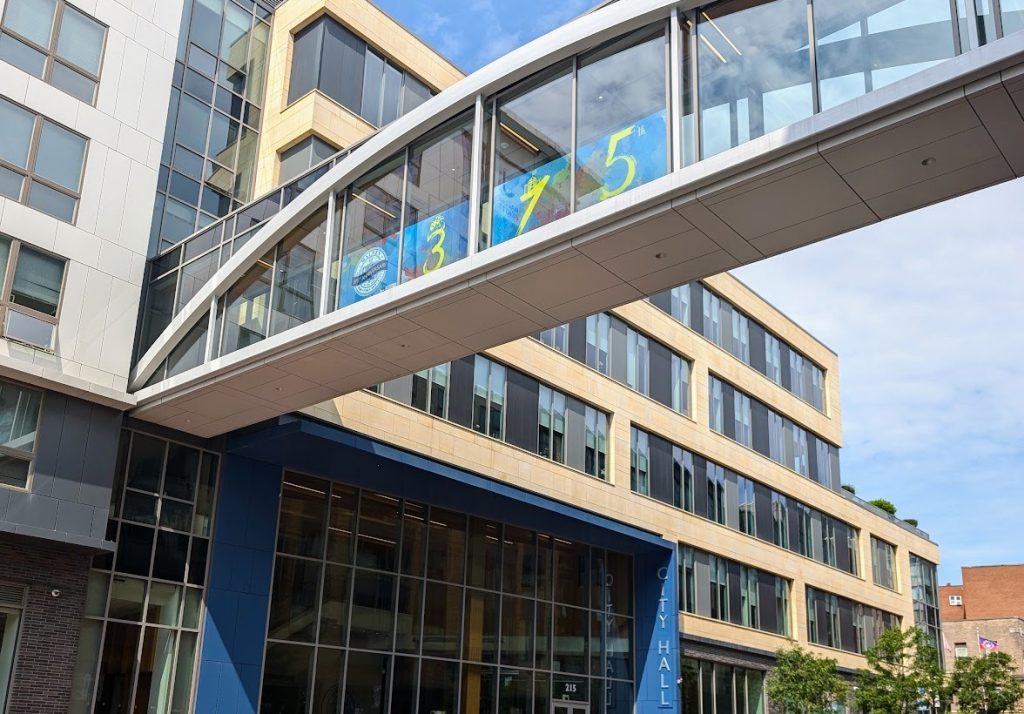
Linehan sees the goal as building on the success of the city’s Gaming District and restaurant scene and capitalizing on Malden’s transit proximity and surrounding neighborhoods to create a thriving, expanded city center that is more walkable, better connected to where people live and capable of attracting a vaster array of small businesses that have the tools to succeed.
“Right now, our core downtown can feel hard to access, and there’s tremendous potential to build spokes up Summer Street, across Route 60, down Salem Street and beyond, so the elements that make our downtown exciting start to benefit and draw in a broader cross-section of Malden,” she said. “The timing of this in tandem with our upcoming Comprehensive Plan also feels synergistic. We will be well positioned to make planning and policy changes needed to support exciting economic development ideas that emerge.”
The win was a collaborative effort involving a broad coalition of local groups, including the Malden Chamber of Commerce, Creative Malden, First Seed Sown, the Greater Malden Asian American Community Coalition (GMAACC), Malden Arts, Malden Creates and Urban Media Arts, which is the parent organization for Neighborhood View. Under the TDI Partnership model, community leaders get deeply involved in guiding development efforts by working with the city’s TDI fellow to define goals, brainstorm strategies and decide how to measure success.
Linehan noted that arts and culture and place-making partners are featured prominently in the program’s goals.
“We have a strong creative sector working in Malden and seeking additional professional opportunities here in the city,” she said. “As development pressures push more working artists out of neighboring communities like Boston, Cambridge and Somerville, we should be poised to capture that opportunity to create creative spaces.”
The city has some 2,500 housing units within easy walking distance of City Hall Plaza, in addition to people getting off the train or coming downtown to shop or visit a restaurant, priming Malden for a new round of creative development in partnership with local groups.
“We are excited to strengthen community-rooted infrastructure, support local economic vitality and help cultivate vibrant, culturally grounded spaces for our communities,” said Mina Kim, executive director of GMAACC, which is hard at work on its new community center not far from downtown.
Malden joins a 2026 cohort of TDI communities that includes Chelsea, Fitchburg, Holyoke, Lowell and Peabody.
Safer streets for neighborhoods
Complementing the downtown economic focus, a new $500,000 MassDoT grant will help fund physical infrastructure projects to make drivers, bikers and pedestrians safer as they move around the city.
Improvements on Lebanon St., extending from the Melrose border to Maplewood Square, will include curb extensions, crosswalks and a reconfiguration of the Swains Pond Ave. intersection that’s designed to reduce speeding.
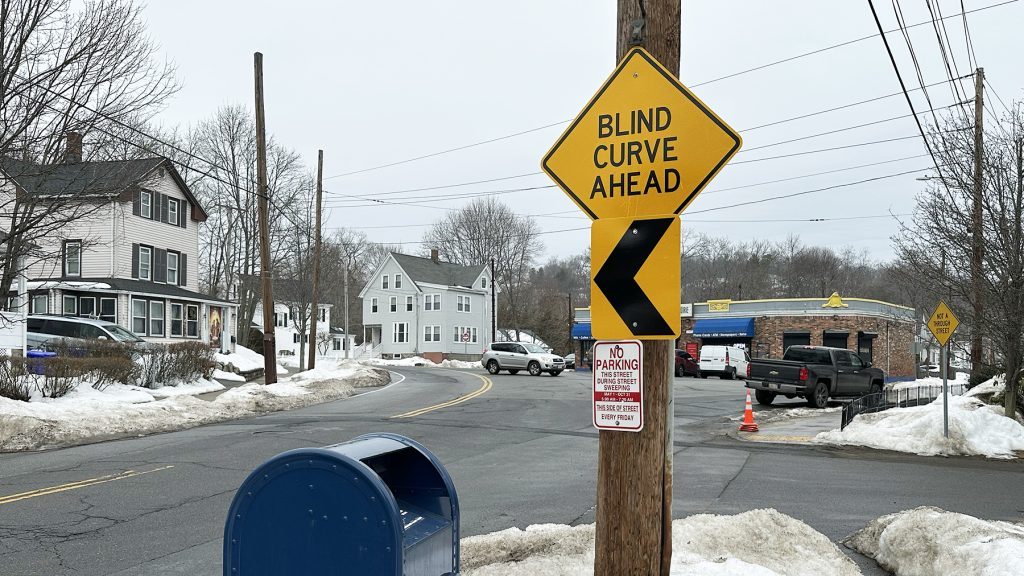
This intersection is notoriously confusing for drivers and pedestrians due to the angles, while Lebanon St. is a major cut-through for commuters avoiding Route 1, leading to ongoing speeding issues.
“Valley at Lebanon has the most crashes of any unsignalized intersection in the city,” said Ward 6 Councilor Stephen Winslow. “This stretch has been on our Complete Streets priority list for nearly 10 years, so I am glad the funding is being provided.”
Winslow added that the city had held off on improvements until lead pipes and gas work was complete, so the funding is timely.
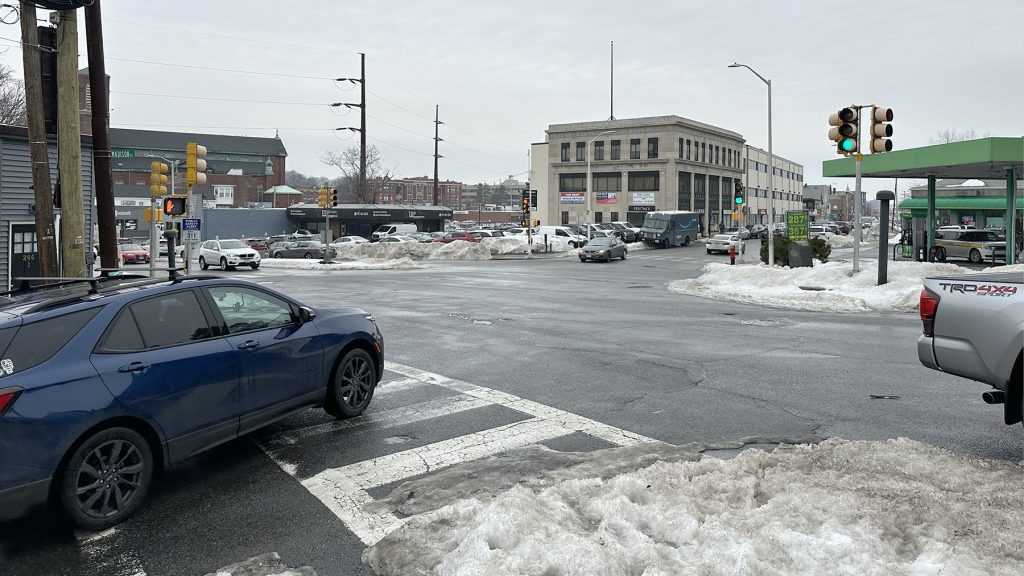
The complex intersection of Main St., Eastern Ave. and Madison St. will see the installation of protected left turns, pedestrian signals, and curb ramps.
A strategy of grant-funded growth
Both the TDI designation and the MassDoT award forward Malden’s strategy of seeking external funding for local improvements. According to city officials, the Office of Strategic Planning and Community Development has secured more than $37 million in grant funding since July 2021.
“These kinds of grant opportunities are invaluable as we navigate local fiscal constraints,” said Mayor Gary Christenson. “They truly give us the opportunity to do more for our residents with less.”
In regard to the TDI designation, Linehan added that with a tax override on the ballot in March, finding a no-cost program this extensive that can recommend ways to grow the city’s economic base is invaluable.
“The fact that it will be grounded in public engagement, on-the-ground work with our business community and include our artists is a win-win-win,” she said. “I’m excited for whatever role the Council can play to support.”



Be the first to comment