
By Lorna Garey
In a lengthy session on Tuesday, October 20, with all members in attendance, the City Council voted on a controversial $2.2 million park funding reallocation, enacted commercial zoning updates, approved key municipal budget transfers and confirmed new leadership for city commissions.
There were three moments of silence offered for longtime community members Jimmy Stanley, remembered by Councilor Chris Simonelli; George Burgess, husband of former City Clerk staffer Carol Burgess, noted by Councilor Jadeane Sica; and Patricia Lipani, the mother of Clerk of Committees clerk Lisa Cagno, remembered by Councilor Peg Crowe.
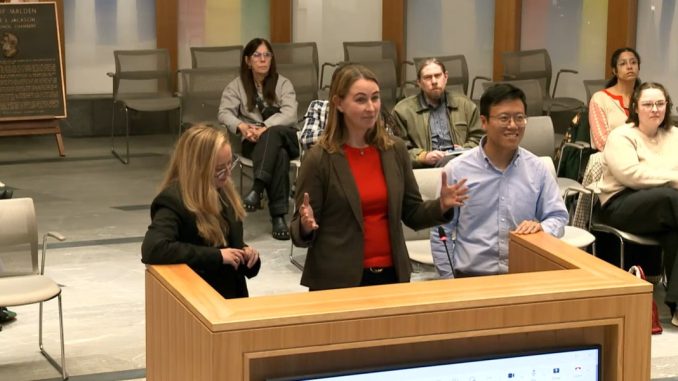
To kick off the meeting, members of the city’s Climate Action & Sustainability Commission submitted their first annual report evaluating progress on the city’s Climate Action Plan. Highlights include:
- 30% lower municipal energy use since 2016 via seven municipal electric vehicles and four chargers
- $15.8 million secured for climate and energy projects since the Climate Action Plan was published in 2024
- Residents completed more than 1,000 home energy assessments, 425 weatherization projects, and 243 heat-pump installations in 2025
- The city reported 21 million pounds of cumulative CO₂ reductions and more than $4 million in resident electricity savings through Malden Community Electricity
Other achievements for the committee include the SolSmart Bronze designation for Malden, seven shaded bus shelters, expanded Blue Bikes, more than 1,000 trees planted, a completed pocket forest and the opening of Malden River Works. A $50,000 Bloomberg youth climate grant is being allocated to residents ages 15 to 24. The commission newsletter has 162 subscribers.
“This is showing that taking tangible steps, both small and large, are possible here in Malden, and those accumulate,” said Councilor Stephen Winslow.
During public comment, the council heard from residents and entered six letters into the official record.
Resident John Saia and the Friends of Roosevelt Park requested that funding be earmarked to restore the park’s former outdoor classroom and hedge against potential remediation cost overruns. Pointing to lead contamination discovered in 2019, Saia called for a halt to funding for the Malden River Works park until Roosevelt is fully remediated.
Marcia Manong, chair of the Malden River Works Steering Committee, expressed mixed feelings regarding the funding repurposing. While noting MRW’s need, Manong emphasized that MRW never intended to compete with Roosevelt Park. She criticized municipal processes that she said excluded public dialogue.
Residents Mark Connors and Mark Nolan submitted comments backing proposed Inclusionary Zoning and Use Table updates, with Nolan arguing that mandatory parking minimums drive up rents and stall small projects.
Resident Katie Dillon took the podium to support updates to inclusionary zoning, though that proposal was delayed to next week.
“Lowering the affordability percentage will allow us to actually build affordable and market rate housing, which we sorely need in this community and in others,” said Dillon. “We can revisit this part if needed at a later time if the market changes. But right now, we’re accomplishing nothing by keeping the affordability rate where it is. Homelessness and housing insecurity are both increasing, especially among our elderly population. One of the antidotes to this is creating more housing, and this new change will allow us to do that.”
Avoiding the IRS’s ire with a $2.2 million allocation shift
The most contentious debate of the evening centered on Paper 393-26, related to $1,292,045 in available cash funds, and Paper 394-26, regarding $938,174.50 bonded for a Roosevelt Park project that was canceled in 2024 due to higher than expected costs and community pushback against a synthetic field. The city is looking to reallocate funds to pay for a boathouse and DPW salt shed at Malden River Works, rather than taking on new borrowing or drawing from city reserves.
When a city issues bonds for capital projects, the IRS expects the borrowed money to be spent expeditiously, typically within three years. Because the Roosevelt Park project faced extensive delays and the city ultimately canceled the work the 2023 bond was meant to pay for, that borrowed cash sat unspent in a municipal account much longer than expected. This can negatively impact the city’s future borrowing ability and expose it to penalties related to interest earned. Because the Malden River Works is also a park, it’s an opportunity to shift those funds to a project the IRS will deem eligible.
Finance Committee Chair Carey McDonald outlined the legal and financial necessity of the move, explaining that while Roosevelt Park’s active soil remediation is fully funded through a HUD Section 108 loan, the original park project’s cancellation caused the previous bonding authorizations to expire.

“When we put the city’s credibility on the line to go out and borrow money, it has to be for a specific project,” said McDonald. “If we cancel the project and then we don’t spend the money and we just sit on it, that can impact our credit rating.”
A dinged credit rating could jeopardize funding for any future Roosevelt Park plan, they pointed out, adding that if there are remaining funds when the salt shed and boathouse are completed, it will be available for use.
“That’ll be the first place we go for planning costs for the next stage of whatever comes next at Roosevelt,” said McDonald. “I appreciate that most of this conversation has been relatively civil. I know that this is a fraught issue in our community.”
Ward 5 Councilor Ari Taylor, whose district includes Roosevelt park, reassured residents that transferring the money is both vital for the city’s fiscal health and not meant as a slight but rather the council safeguarding the city’s financial future.
“Voting to move this money is not a vote against Roosevelt,” said Taylor. “When we’re able and we have a plan to move forward, to be able to get funding, we will be in a better place because we will have a better bond rating.”
She added that there is money allocated to restore the Roosevelt garden/outdoor classroom.
“That is the project that’s at hand,” said Taylor. “That project is funded, and so soon, for the first time in seven years, it’ll be fully open, and we’re looking forward to that.”
Councilor Stephen Winslow added that Malden River Works plans are “99% done” and ready to go out to bid, and he noted that any construction delays due to not using the bonded funding would inflate costs for the salt shed and boathouse given runaway inflation.
Councilor Karen Colón Hayes proposed carving out $200,000 from the funds to serve as seed money for an as-yet-uncontracted architectural plan for Roosevelt Park, launching a lengthy discussion among the council and city staff.

“We’re being told that by holding on to this bond and not spending the money, that it could hurt us financially in the future by getting bonds, which I understand — I get that,” said Colón Hayes. “To develop a comprehensive plan, I believe this $200,000 would be money well spent, so that we’re not in a position like we’re in now, where we’re saying the only reason why we’re moving it … is because the River Works has a plan.”
However, City Treasurer Dan Grover and OSPCD Director Alex Pratt clarified public finance restrictions.
“You cannot reallocate $200,000 to a nonexistent project,” said Grover. “If you do not have a plan to spend the money within the next three to four months, then that is also going to be problematic.”
Pratt added that IRS rules prohibit municipalities from holding interest-bearing bond proceeds without active project expenditures.
Councilors Michelle Luong and Chris Simonelli supported Taylor’s position.
“I just wanted to let Councilor Taylor know that she has my full support in whatever she needs,” said Luong. “I fully support moving the money over to the Malden River Works and securing and protecting our bond rating. But more importantly, as councilor at large, Councilor Taylor knows she can reach out should she need any help [with Roosevelt]. I have full confidence in her ability to move this whole project forward.”
Simonelli reiterated his interest in ensuring ward councilors have control over what happens in their neighborhoods and called out the reality of municipal funding.
“Here’s the thing: If you get $200,000, you end up starting to do things piecemeal, and then things don’t get done because then you can’t find the funding the following year — some spigots are turned on, some are turned off, and I’d rather have a comprehensive plan,” he said. “I think there’s a lot of healing that needs to begin in the [Roosevelt] neighborhood, and, I think that going back to the drawing board at this point is not a bad thing.”
Councilor Ryan O’Malley, who ultimately voted in favor of the transfer but said he would have supported the $200,000 carve out, commended Council President Amanda Linehan for allowing Colón Hayes to fully vet her proposal.
“I also agree with Councilor Taylor that moving the funds is not against Roosevelt,” said O’Malley. “Thanks for having this conversation. I think it was beneficial.”
After discussion, Colón Hayes withdrew her proposal. On separate roll-call votes, both papers passed 10 – 1, with Colón Hayes casting the sole negative votes.
Major zoning use table reform enacted, inclusionary zoning still on hold
Highly anticipated inclusionary zoning papers that are on a tight deadline were removed from the docket as they remain under committee review. Linehan clarified that the papers were added to the agenda in case they were ready to come out of committee, but they did not end up being voted out and are pending legal review of several proposed amendments.
The deadline to act is November 10, and she said there will be a City Council meeting next week to address inclusionary zoning.
The council did act on a recommendation from the Committee on Rules and Ordinance regarding Paper 327-26, sponsored by Councilors Taylor, Winslow and O’Malley. The order updates Section 12.12.030 of the zoning code to streamline commercial permitting across Residential-Office, Business and Industrial districts.
Winslow explained that the committee elected to split the proposal into two tracks:
- Paper 327-26 advances 15 specific commercial use updates, converting restrictive special permit requirements into by-right allowances to hopefully help fill vacant storefronts. It was enrolled by unanimous voice vote.
- Paper 327A-26, which remains in committee, peeled off three higher-impact uses — hotels/motels, fast-food restaurants and supermarkets — that were recommended by the Planning Board for site plan review. Action was deferred until that review text is drafted.
Municipal finance, infrastructure & enterprise funds
The council enacted several financial measures:
- Net school spending fix: The council unanimously approved transferring $400,000 from the Group Insurance account to the Malden Public School Department. McDonald explained that annual end-of-year calculations revealed a $400,000 shortfall in state-mandated net school spending compliance due to healthcare cost shifts.
- Ride-share mobility improvements: The council was also unanimous in appropriating $266,174 from the Transportation Network Company (TNC) surcharge account derived from Uber/Lyft rides. Bundled with Chapter 90 funds, the money will construct ADA-compliant wheelchair ramps, curb cuts and audible pedestrian signals across nine key intersections, including Pleasant & Highland, Ferry & Belmont, and Medford & Commercial.
- Enterprise and stabilization funds ordained: The council formally established a Solid Waste Enterprise Fund starting in FY2028 and a governance framework for General Purpose and Short-Term Capital Stabilization Funds.
Two additional measures moved to committee:
- Streamlining union salary ordinances: Sponsored by Winslow, this proposed ordinance amends MCC 2.24.010 to remove static union salary tables from the code, substituting direct links to ratified Collective Bargaining Agreements online.
- Snow storage zoning: Who can forget the Snow Mountain? Not the City Council, which referred to committee a proposed zoning amendment outlawing use of lots as snow storage sites. O’Malley suggested that there may be exemptions for snow that is native to Malden.
The council held public hearings on two National Grid infrastructure petitions:
- Pearl Street: The council approved a petition to install one pole and 175 feet of underground conduit near Medford Street. Special Assistant to the Mayor Maria Luise reported that Mayor Gary Christenson coordinated with the nearby Malden Islamic Center regarding disruption of Friday worship; the petition was granted unanimously with the explicit condition that no construction work occur on Fridays.
- Lynn Street: Following property line and MBTA right-of-way boundary questions raised by Winslow, the council voted to split the petition to relocate poles near Oliver Street, with one petition granted subject to strict ADA sidewalk clearance compliance and another tabled pending right-of-way survey confirmation.
Board confirmations
Acting on reports from the Personnel & Appointments Committee, the council approved a slate of local measures by:
- Confirming Friends of the Malden River cofounder Karen Buck to complete an unexpired term on the Public Works Commission through March 1, 2027.
- Confirming four members to the newly reorganized Parks & Recreation Commission: Heather Barry, Ben Gately, Julie Turner and Jane Ventrone. Winslow noted he will draft an update to the Community Preservation Committee ordinance to integrate a designated Parks & Rec delegate.
Personal privilege & community announcements
Councilors shared updates before adjournment.
Ryan O’Malley announced the installation of two new steel animal sculptures — American Dog and Fox, both by local artist Dale Rogers — at Coytemore Lea Park to join the popular Wise Owl sculpture. O’Malley shared that he is authoring a children’s story featuring the three sculptures to promote park stewardship.

Peg Crowe highlighted upcoming Bell Rock Cemetery walking tours led by Mark Linehan this weekend beginning at 11 a.m. and the Ward 2 Trunk-or-Treat on the Canal Street Bike Path on Sunday from 1:30 to 3:30 p.m.
Ari Taylor invited families to the Haunted Woods at Pine Banks on Saturday from 6 – 8 p.m.
Steve Winslow noted Salemwood School’s Trunk-or-Treat on Friday at 6 p.m. and the Malden Warming Center Gala at Anthony’s, also on Friday.
Carey McDonald detailed early voting schedules in the City Hall lobby running through Oct. 29 and a mobile early voting session at the Eastern Ave. Police Station on Friday, Oct. 23, 10 a.m. – 2 p.m.
Executive session adjournment
At the conclusion of open business, the council entered executive session with legal counsel to discuss charges brought against a public employee in the matter of Joel Jeannite v. Officer Patrick Kinnon, and to evaluate legal representation and indemnification. Luise was admitted to the session.


Be the first to comment