
By Kim Brookes
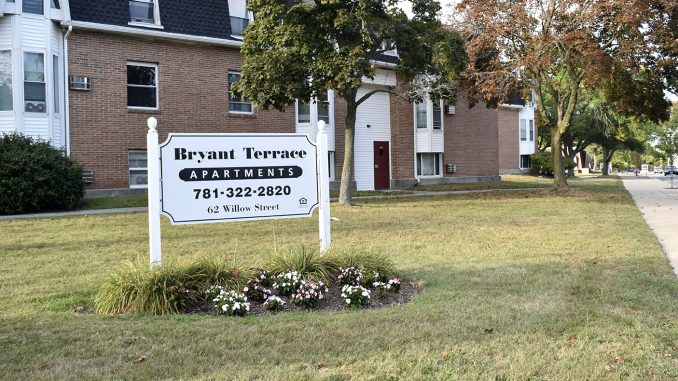
When residents at Bryant Terrace Apartments opened their mailboxes in August, some found lease renewal letters announcing significant rent increases on units long considered affordable — increases the board members controlling the nonprofit that owns the complex say they had no choice but to implement. This illustrates a structural dilemma facing older, historically affordable developments across the state: How can a nonprofit board battling runaway operational inflation, zero government subsidies and strict code mandates keep going without pricing out the very people it seeks to serve?
That question is hitting home in Malden.
“Bryant Terrace is operated as a nonprofit community,” wrote Property Manager Kelli McCool in the letter sent with lease renewals to tenants. “To continue providing safe, well-maintained housing, we must make ongoing costly investments to meet city and state fire code requirements, complete necessary building improvements, and enhance residents’ overall living experience. These increases are not for profit; all funds collected at Bryant Terrace are reinvested directly back into the property to support its long-term sustainability for our residents.”

Those investments mean that, after years of modest upticks, the monthly rent for Linda Shapiro’s three-bedroom unit at 220 Bryant St. was set to increase by $400 per month, from $850 to $1,250, effective Nov. 1. Just twelve months earlier, in late 2025, rent for the unit had risen from $750 to $850.
That’s a combined increase of 66% in two years. When Shapiro moved in, in 2001, rent was pegged at 30% of her income.
“When I asked why they were doing this, [a management company employee] said it was because they can’t pay their bills,” said Shapiro. “I said to her, ‘If you’re going to go up this much, can I get new cabinets? Can I get new this, new that?’ She told me no, that I’d have to move into an apartment that’s already renovated and pay full market rent.”
Shapiro and other long-term tenants told Neighborhood View that their apartments haven’t been painted or had worn rugs replaced since they moved in. Only broken appliances have been addressed.
A hard balance sheet reality
Kenny Mazonson, treasurer of Agudas Achim Development Corp., which owns the Bryant St. complex, said that for years, many tenants — who do not need to be income-qualified for their units — paid rents well below what the market would bear.
“There are people who’ve been living at Bryant Terrace for 30 to 40 years, paying less than $600 a month for a one bedroom,” said Mazonson. “Many other existing tenants who moved there in the past five to 10 years, and had their apartments refurbished prior to taking occupancy, had been paying $1,298 per month and have just had increases to $1,400 a month.”
Mazonson said the plan is a minimum rent of $1,000 per month for one-bedroom apartments, with new tenants in renovated units paying around $2,000 per month. That $1,000 might represent a significant increase for some long-term tenants, but even the $2,000 figure is 30% to 40% less than many units in Malden, he said, citing complexes on Dartmouth and Main Streets where one-bedroom units start at around $2,300.
A long history of service
Agudas Achim Development Corp., a tax-exempt 501(c)(3) nonprofit entity incorporated in June 1965, originally had as its sole mission to operate government-subsidized housing under Section 221(d)(3) of the National Housing Act. The Bryant complex includes 109 apartments across 11 buildings and two commercial buildings with a total of eight units. Mazonson and David Posner, who together comprise the board, said Agudas Achim bought the land from the Malden Redevelopment Authority in the mid 1960s, when urban renewal displaced many residents of the historically Jewish Suffolk Square.

Unlike subsidized developments backed by recurring government grants, Agudas Achim reported $0 in gifts, grants or government contributions in 2024. Without outside funding, every cost increase — from building insurance and utility repairs to state fire code compliance — must be covered by either the organization’s reserves or tenant rental income.
Because the board has long aimed for minimal increases, over just two years, from 2022 to 2024, the nonprofit’s net assets dropped from $2.02 million to $1.45 million, an unsustainable trajectory, said Mazonson. According to IRS Form 990 filings and financial records, in fiscal year 2024, ending Sept. 30, 2024, Agudas Achim generated $1,192,900 in revenue, primarily from rent payments, against $1,530,567 in operating expenses.
The result was a net deficit of $337,667 on top of a $227,664 loss in FY 2023. The board may not be able to qualify for grants or loans because it has spent down the nonprofit’s savings, and the costs keep adding up.
“We have a mandate from the city’s Fire Department that each unit have a hardwired fire alarm so the alarms ring right at the station,” said Mazonson. “That will cost $1.4 million.”
The board was raising rents in increments of $25 per year, but that has not provided enough capital to keep up with expenses.
“Three major cost increases made us go into our savings: Real estate taxes are up 5%, property insurance doubled and water is up 7%,” Mazonson said. “There are other repairs we need to make. The windows will need replacing. The asphalt in the driveways and parking lots has to be done.”
Life after the HUD loan
Bryant Terrace’s operational model isn’t unique. The property was originally financed with a 40-year HUD/FHA mortgage paired with federal rent supplement subsidies. During those decades, eligible tenants paid 25% to 30% of their income toward rent, while HUD reimbursed Agudas Achim for the difference between those payments and the market value of each unit.
Around 2005, the original 40-year mortgage was paid off. While eliminating mortgage debt provided long-term independence, it also marked the end of federal rent supplement contracts that had sustained the development. Today, Bryant Terrace operates as independent nonprofit housing. Tenant rents are set by the board and are meant to cover actual operational costs, without assistance from federal voucher subsidies.
Although rents are lower than Malden’s market rate, Bryant Terrace is not classified as officially affordable, where tenants are income-qualified to pay those below-market-rate rents. It’s considered naturally occurring affordable housing, or NOAH; that is, residential rental properties that are affordable to low- and moderate-income households without the use of government subsidies, tax credits or deed restrictions.
According to McCool, the minimum income requirement for new tenants is three times the monthly rent; for a one bedroom, this translates to an income of $6,000 per month. Nonetheless, Malden’s Housing Authority refers people to Bryant Terrace, because it’s still below market rate.
That the complex is not officially on the affordable rolls also means it could be sold to a private developer or investor, which could purchase the buildings, renovate the units to command market-rate rents, and permanently remove them from the accessible housing supply.
For residents who can’t afford market rates, to bridge the gap, management provided residents with references to local emergency housing stability resources, including:
- Metro Housing RAFT Program: Offers up to $7,000 over 12 months for emergency rent and utility payments for households earning under 50% or 60% of AMI.
- City of Malden Office of Housing Stability: Provides legal support, eviction prevention, and fuel/utility assistance.
- ABCD Malden Start Secure Program: Assists residents earning at or below 80% of AMI with initial housing costs and rental assistance.
All of these help, but none of them addresses the root of the problem.
Organizing for stability
Faced with steep increases and no direct appeal pathway, residents have begun organizing. Partnering with Tatiane Oliveira of the Malden Community Land Trust, tenants have formed the Bryant Terrace Tenant Association and collected 35 signatures on a public letter calling on ownership and management to negotiate with residents.
“People are protected when they form tenant associations,” said Oliveira. “The letter includes demands for no rent increases, an opportunity to renegotiate leases that were already signed with increases, protection against retaliation and meaningful resident participation in decisions affecting their homes.”
To Neighborhood View, Bryant St. residents cited complaints including unrepaired flooring, leaks, mold concerns, cracks and inadequate insulation that can push heating bills to $400 monthly in the winter. All heating is electrical, and tenants say windows and openings for the AC units let in cold air. Some don’t heat their bedrooms in the winter.

Mazonson sympathizes but points to the costs borne by the board.
“We’ve replaced the roofs on nine apartment buildings out of 11 for $650,000 in the past two to three years,” he said. “Two apartment buildings and both commercial buildings still need roofs as well. Two, three years ago, the roofs cost about $50,000 to $60,000 each. Now they cost $80,000 each, because the cost of labor and materials has gone up.”
As Agudas Achim and its tenants navigate rising inflation, deferred building maintenance and strict municipal codes, Bryant Terrace highlights the broader challenge of providing affordable housing.
One solution is to add new units in Malden that can receive subsidies and hope the law of supply and demand puts downward pressure on rent increases. That effort hit a roadblock recently. A project, slated for 245 Bryant St. under the auspices of ACDC 245 Bryant LLC, an affiliate of the Asian Community Development Corporation, proposed to create 36 rental units that would be affordable in perpetuity. The permit was blocked by the Malden Planning Board, which failed to achieve the supermajority required by law. Another ACDC project at 213 Main St. that will have 20 income restricted units has just begun preliminary site work; completion is expected in 2028.
Meanwhile, at Bryant Street, tenants and the board are largely in the same leaky boat.
“We just can’t keep making it work,” said Mazonson. “We’re trying to make ends meet.”
Lorna Garey assisted with writing this story.


Housing is such a problem. This was a very informative article. I am glad that you shared this. Hopefully, many people will read this and try to come up with some solutions.
i wish my rent was 1250. cry me a river.